Technical Position Paper · Peer-Reviewed
Understanding Creatine Quality: A Scientific Review of Purity, Standards, and Verification Systems
How creatine purity is scientifically established and how it can be consistently verified across every batch, from every supplier, against the same public standards used throughout the industry.
The Science Hub Editorial Group
Editorial review by experts in sports nutrition, exercise physiology, and clinical pharmacology.
Abstract
Objective
To objectively evaluate the scientific basis of creatine monohydrate quality and distinguish measurable analytical parameters from commercially driven terminology. This paper examines how creatine purity is scientifically established against publicly available regulatory and pharmacopoeial standards; assesses the relevance of critical impurity thresholds — dicyandiamide, dihydrotriazine, and creatinine — and their associated analytical testing frameworks; and describes the supply-chain verification and manufacturing control practices through which a responsible manufacturer ensures purity, identity, and batch-to-batch consistency across raw materials sourced from multiple global manufacturing ecosystems.
Contents
Section 1 · Molecular Identity
Creatine monohydrate is one molecule
Creatine monohydrate (CAS 6020-87-7) is a chemically precise compound with the molecular formula C₄H₉N₃O₂·H₂O and a molecular weight of 149.15 g·mol⁻¹ as the monohydrate form. It possesses a fixed molecular structure with no chiral centre and no commercially relevant polymorphic forms. Once a batch is confirmed through assay and identity testing to be creatine monohydrate, it is — at the molecular level — the same compound irrespective of the manufacturing facility that produced it. Its bioavailability and physiological behaviour are determined by this structure; structurally identical material exhibits identical biological behaviour.
The same compound is commercially available in different particle size distributions — standard, micronised, and ultra-micronised — produced by milling or controlled crystallisation processes. These variations alter the physical characteristics of the powder, such as dissolution rate and dispersibility, but leave the underlying molecular structure entirely unchanged. A finer mesh size means the particles are smaller; it does not mean the molecule is different. The ergogenic mechanism and biological activity remain constant across all particle size variants, as they are properties of the molecule itself, not of its physical form.
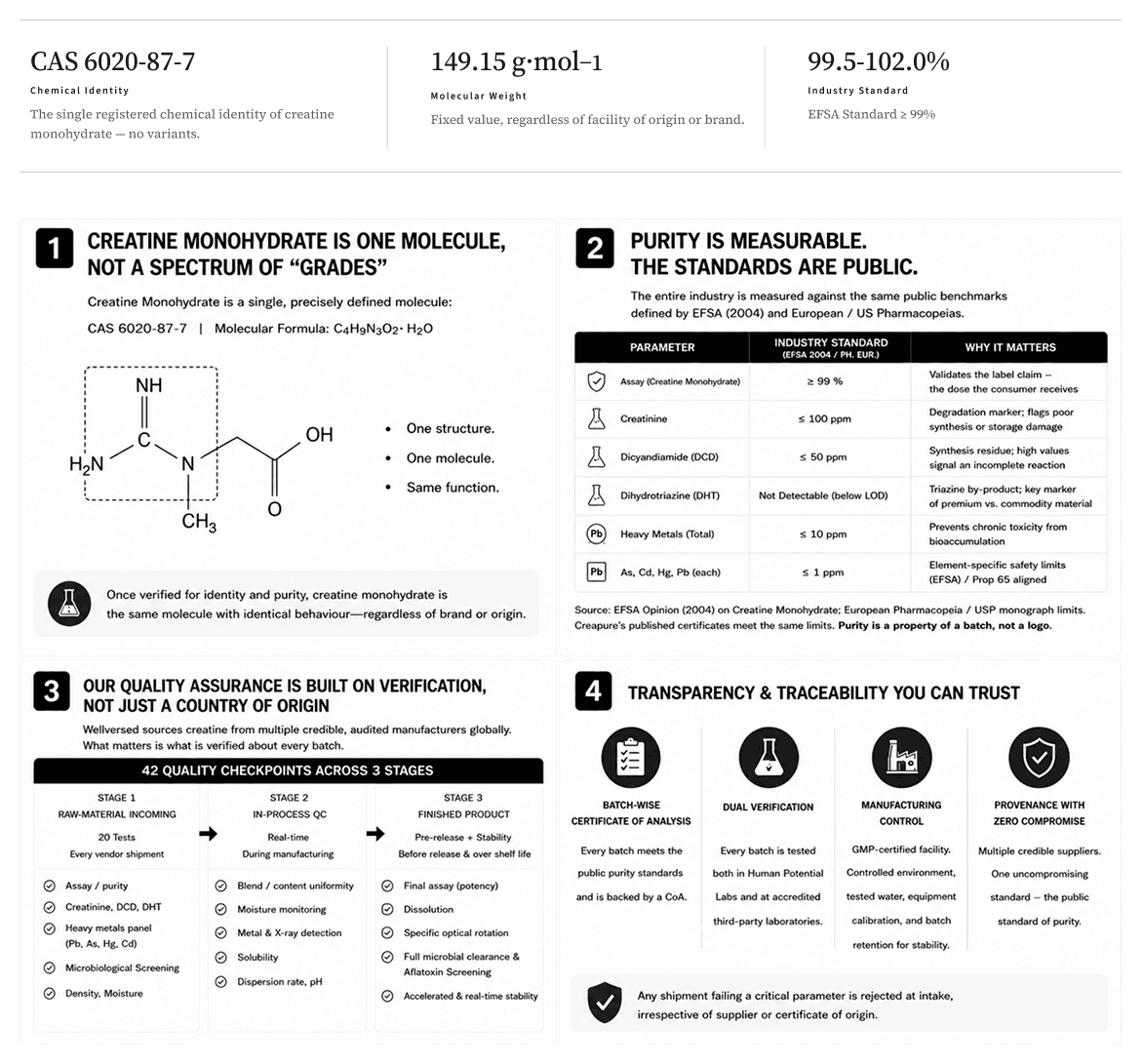
A Note on Brand Names and the Molecule
Purity is a measurable, documentable property of a batch — not a property of a trademark. Any creatine product can be analytically evaluated against the same publicly available pharmacopoeial and EFSA-recommended safety ranges that serve as the universal industry reference. What differentiates a quality manufacturer from a commodity supplier is not the label they carry, but whether they consistently measure against these benchmarks and maintain verifiable, reproducible documentation of compliance on every batch.
Section 2 · Purity Standards and Impurity Profile
What Purity Actually Means: Publicly Defined Standards, Not Proprietary Claims
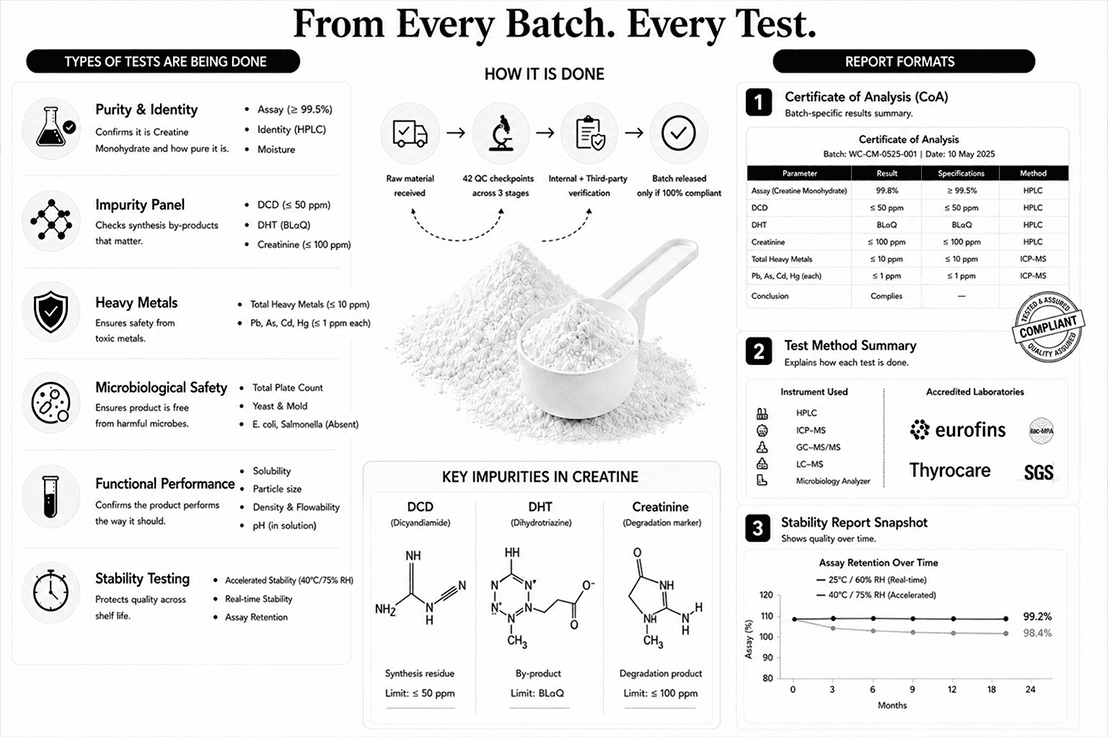
Creatine monohydrate, even when correctly synthesised, can carry process-derived impurities that are inherent to its industrial manufacturing route. Creatine is synthesised from sarcosine (N-methylglycine) and cyanamide through an aqueous condensation reaction conducted at 90–100°C and pH 7–9. This synthesis pathway, by its chemical nature, can give rise to three critical residual impurities — each of which is analytically measurable and addressed by publicly available regulatory guidance.
The European Food Safety Authority (EFSA, 2004) and both the European and United States Pharmacopoeias have publicly recommended safe ranges for these impurities, providing an open, verifiable reference framework against which any batch of creatine monohydrate can be evaluated.
The three impurities of scientific significance are:
- Dicyandiamide (DCD) — also known as cyanoguanidine; a residual unreacted precursor arising from cyanamide dimerisation during synthesis.
- Dihydrotriazine (DHT) — a cyclisation by-product generated under conditions of elevated temperature or alkaline pH during the reaction or crystallisation stage.
- Creatinine — a spontaneous cyclisation product of creatine itself, serving as an indicator of synthesis process control and post-synthesis storage integrity.
These three parameters represent the scientifically established checklist for evaluating creatine quality — and the reference values against which they are assessed are publicly available, not defined by any single manufacturer or commercial interest.
Table 1
Purity standards for creatine monohydrate
| Molecule | FSSAI | Industry Standard | Why It Matters | Biological Impact |
|---|---|---|---|---|
| Assay (creatine monohydrate) | Not specified | 99.5–102.0% | Validates the label claim — the dose the consumer actually receives. | Stored as creatine phosphate for rapid ATP resynthesis.[1] |
| Creatinine | Not specified | 10–100 ppm | Degradation marker; flags poor synthesis control or storage damage. | Not inherently harmful — the body naturally produces ~1.7 g/day as an endogenous metabolite. |
| Dicyandiamide (DCD) | Not specified | ≤ 50 ppm | Synthesis residue; elevated values signal incomplete cyanamide consumption. | Extremely low toxicity with no adverse effects in animal or human studies.[8,9] |
| Dihydrotriazine (DHT) | Not specified | Below Limit of Quantification (BLoQ) | The single most discriminating marker between premium and commodity-grade material. | No direct human toxicity data exist; however, structurally related triazines are known carcinogens.[10] EFSA mandates non-detectable levels (<4.5 mg/kg) on precautionary grounds.[2] |
| Total Heavy Metals | ≤ 10 ppm | 5–10 ppm | Prevents chronic toxicity from bioaccumulation across the consumer lifecycle. | Non-biodegradable; accumulate in soft tissues over time. Chronic low-level exposure is linked to oxidative stress, mitochondrial dysfunction, endocrine disruption, nephrotoxicity, and neurotoxicity. |
| Individual Heavy Metals (As, Cd, Hg, Pb) | < 1 ppm | 0.1–1 ppm | Element-specific limits per FSSAI and ICH Q3D Class 1 elemental impurity standards. | As: IARC Group 1 carcinogen; Cd: IARC Group 1 carcinogen; Hg: neurotoxic, cognitive impairment; Pb: no safe threshold, inhibits haem synthesis, causes neurocognitive deficits and nephropathy. |
Certificates of Analysis from any responsible manufacturer should report values at or within these publicly recommended ranges. The reference standard itself is universal and openly accessible — what varies across manufacturers is not the target, but the rigour with which it is measured, the frequency at which testing is conducted, and the depth and traceability of the documentation maintained to support compliance claims.
In practice, this means that evaluating creatine quality is less a question of which limits apply — those are fixed and public — and more a question of how consistently and transparently a manufacturer demonstrates adherence to them across every production batch.
Section 3 · Supply-Chain Verification
The real science is supply-chain verification — not sourcing from one country
A scientifically sound approach to creatine quality does not anchor itself to a single country of origin or a single company or proprietary trademark as a proxy for purity. Country of origin is one contextual input into quality assessment — it is not a substitute for it. Responsible manufacturers source from multiple audited and certified global suppliers, and apply the same rigorous verification protocol uniformly, regardless of where a given batch originates.
The scientifically meaningful question when evaluating any incoming raw material is not “which country did this come from?” but “what has been analytically verified about this specific batch?”
Best practice in raw material procurement therefore requires a structured,
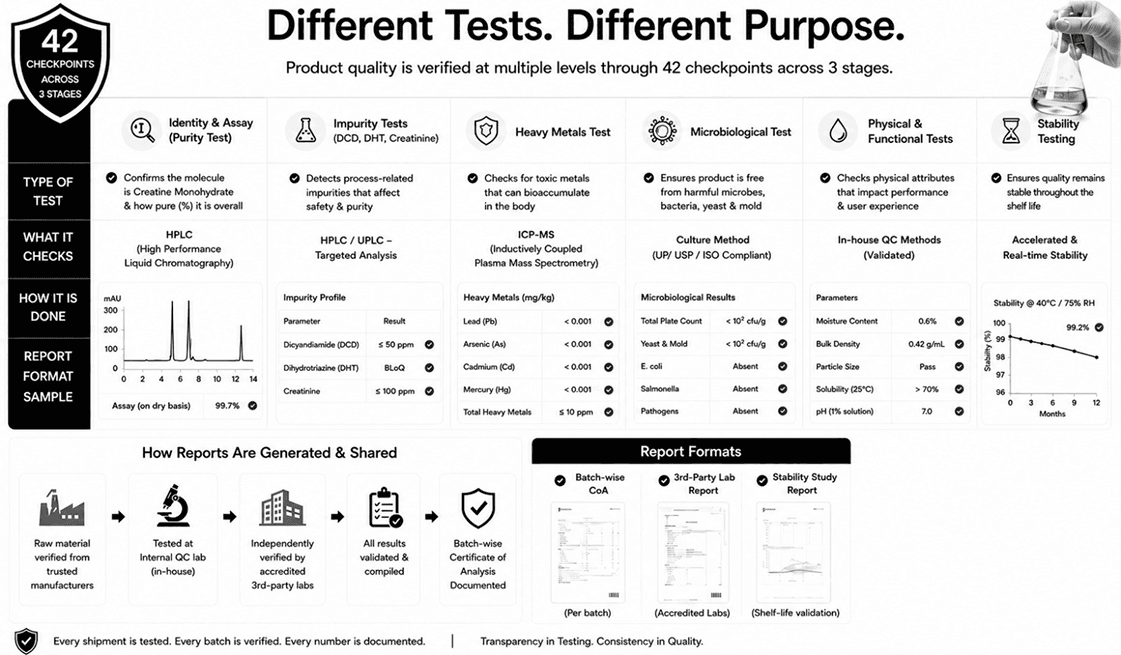
multi-stage quality protocol applied to every incoming lot — irrespective of supplier, geography, or accompanying documentation. Relying solely on a supplier-issued Certificate of Analysis, without independent verification, introduces an uncontrolled variable into the quality chain. A robust supply-chain verification framework defines a minimum of three distinct stages of quality control, encompassing no fewer than 42 defined checkpoints that every batch must clear before entering the manufacturing process. This layered structure ensures that no single point of failure can compromise the integrity of the final product.
This approach — systematic, documented, and supplier-agnostic — is what distinguishes a process-driven quality system from one that depends on the reputation of a source rather than the reproducibility of its data.
Table 2
3-stage QA/QC protocol — 42 checkpoints across the supply chain
Stage 1 alone tests every incoming shipment for all parameters in question: assay, creatinine, DCD, DHT, and heavy metals.
| Stage | Scope | Representative Parameters |
|---|---|---|
Stage 1 — Raw-Material Incoming 20 tests · Every vendor shipment | Every vendor shipment, regardless of supplier or origin. | Assay / purity (HPLC), creatinine, DCD, DHT, heavy-metals panel (Pb, As, Hg, Cd — ICP-MS), microbiological screening, particle size, density, moisture (LOD), pH, visual and sensory evaluation. |
Stage 2 — In-Process QC Real-time · During manufacturing | Active monitoring at critical control points throughout the manufacturing process. | Blend uniformity and content uniformity, moisture monitoring, metal-detection, solubility, dispersion rate, pH, fill-weight accuracy, seal integrity. |
Stage 3 — Finished Product Pre-release + stability | Comprehensive batch release and ongoing stability monitoring before any product reaches a consumer. | Final assay (potency ≥ 99.5%), dissolution, specific optical rotation, complete microbiological screening (TAMC/TYMC, Salmonella, E. coli, Staph, Pseudomonas), aflatoxin testing, accelerated and real-time stability (ICH guidelines, for selective lot). |
Quality Protocol
Zero compromise on critical parameters
A shipment that fails any critical parameter — including DHT above the limit of detection — is rejected at intake, irrespective of its supplier, country of origin, or certificate of origin. This is the substantive difference between a brand assertion and a supply-chain protocol: a brand name asserts purity once; a supply-chain protocol verifies it on every batch, from every supplier, against the same public standard.
Section 4 · Dual Verification
Verification Must Be Both Internal and Independent
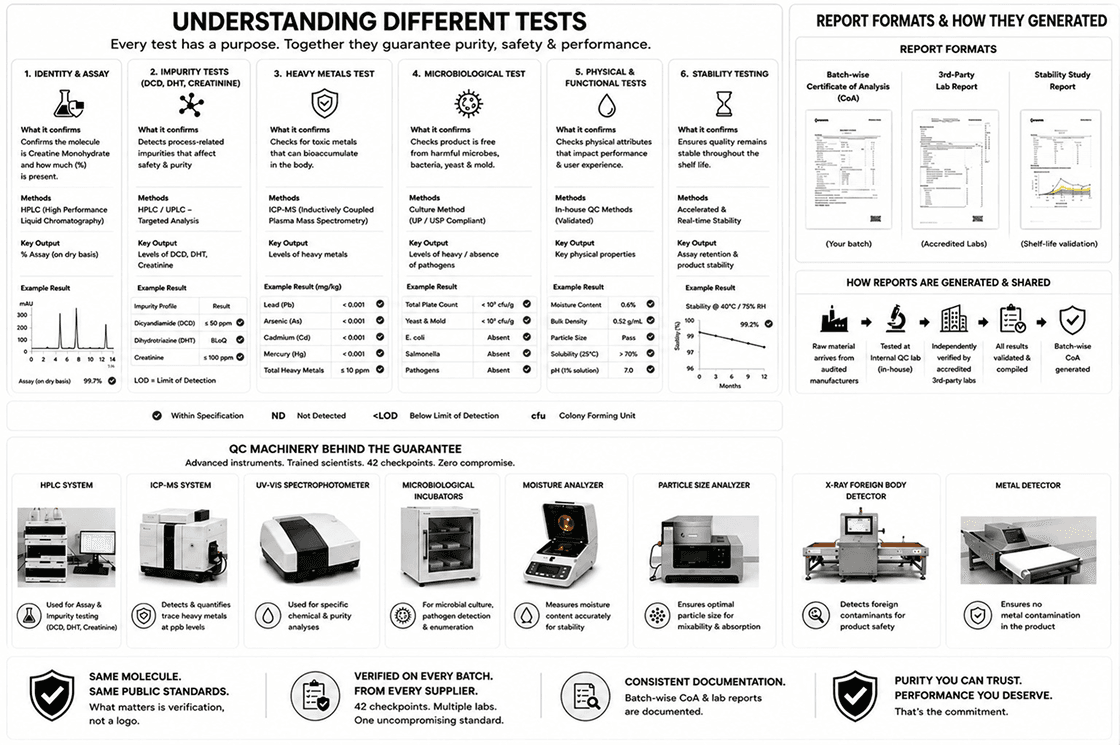
A scientifically credible quality system requires that all procured raw materials undergo assessment at two distinct and independent levels before entering the finished-goods manufacturing process. The first is internal quality control, conducted within the manufacturer's own analytical infrastructure. The second is verification through an accredited external laboratory, operating independently of the manufacturer's commercial interests.
This dual-verification approach serves a specific and important scientific purpose — it eliminates single-lab bias and ensures that the figures reported on a Certificate of Analysis reflect reproducible, independently confirmable measurements rather than a single internal reading that cannot be externally validated.
The external laboratory step is not an optional or supplementary measure. It is the mechanism by which analytical data on a Certificate of Analysis is elevated from an internal assertion to independently verifiable evidence. Without this step, a CoA remains a self-reported document — accurate in intent perhaps, but unconfirmed in fact.
This dual-verification standard is well established in pharmaceutical-grade quality systems and represents the appropriate benchmark for nutraceutical manufacturing as well. Any facility producing a supplement intended for regular human consumption should hold its raw material testing to a standard that is externally confirmable, auditable, and reproducible across batches.
Dual
Verification Approach
Internal + accredited external laboratory verification on every critical parameter.
100%
Sampling Coverage
Incoming batches tested — no sampling shortcuts, no acceptance on CoA alone.
HPLC / LC-MS
Impurity Detection Method
Sensitivity to parts-per-billion level for impurity markers.
Documentation
What "Documented Assurance" means in practice
For every batch released to consumers, internal data and external laboratory data are both documented. This is not a marketing commitment — it is an auditable quality record.
Section 5 · Manufacturing Control
Purity of Raw Material Is Necessary — But Not Sufficient
Confirming the purity of a raw material at intake is a prerequisite for product safety — but it does not, by itself, guarantee the quality of the finished product that reaches the consumer. What happens to a verified raw material during the manufacturing process is equally consequential, and it is at this stage that consumer outcomes are ultimately determined.
A manufacturing facility operating to internationally recognised standards — including GMP, HACCP, FSSAI, and ISO certifications — provides the regulatory and operational framework within which a pure raw material can be reliably converted into a consistent, safe, and accurately dosed finished product. These certifications govern every stage of production, from raw material receipt through to finished product release, and are not incidental credentials — they define the minimum control environment required for responsible nutraceutical manufacturing.
Within such a facility, verified creatine undergoes a defined sequence of unit operations: raw material testing, processing and micronisation where applicable, fluid bed drying where required, sifting and sieving, blending, and packaging — each conducted under documented hygienic and process-controlled conditions.
Every unit operation in this sequence is supported by in-process quality checks designed to ensure homogeneity, stability, and dosing consistency across the entire production batch. This matters for a precise scientific reason — per-serving potency consistency is only achievable when the active compound is uniformly distributed across every unit in a batch. A pure raw material that is poorly processed can still yield an inconsistent or substandard finished product.
“Purity of raw material is necessary for a safe product. Control of the manufacturing process is what makes a consistent pure product. Both are non-negotiable.”
Section 6 · Domestic Manufacturing Capability
Why In-House Synthesis Represents the Highest Standard of Quality Control
The highest standard of creatine quality control is achievable when synthesis and finished product manufacturing occur within a single, vertically integrated facility. This is the quality frontier that separates a genuinely process-controlled operation from one that is dependent on third-party raw material suppliers whose internal process parameters remain partially opaque.
Creatine is synthesised from sarcosine (N-methylglycine) and cyanamide. The three impurities that define quality — DCD, DHT, and creatinine — are not introduced randomly; each is determined at a specific and identifiable point in the synthesis process. DCD levels are governed by the completeness of cyanamide consumption during the reaction. DHT formation is controlled by pH and temperature management during crystallisation. Creatinine accumulation is minimised through precise control of process temperature, drying parameters, and post-synthesis storage conditions.
When synthesis is conducted in-house, every one of these variables — reaction pH, temperature profile, stoichiometric ratios, crystallisation conditions, and drying parameters — is under direct operational control and directly measurable in real time. There is no incoming batch whose process history is unknown or unverifiable. The loop between synthesis and finished product is closed under one accountable, auditable system.
This level of integration represents the most robust architecture for creatine quality assurance — one where impurity control is not managed reactively through testing alone, but proactively through direct command of the conditions under which those impurities are either formed or eliminated.
Table 3
Origin and control mechanisms for the three critical creatine impurities.
In-house synthesis extends quality control to the precise stages at which each impurity is determined.[4,5]
| Impurity | Formed At | Controlled By | Wellcore Limit |
|---|---|---|---|
| Dicyandiamide (DCD) | Synthesis — incomplete cyanamide dimerisation. | Stoichiometric sarcosinate excess (1.05–1.10 mol equiv.); near-neutral pH (7.0–7.5). | ≤ 50 ppm |
| Dihydrotriazine (DHT) | Crystallisation — elevated temperature or alkaline pH. | Crystallisation temperature held below 85°C; pH monitoring throughout. | BLoQ |
| Creatinine | Synthesis / storage — spontaneous cyclisation of creatine. | Process temperature, drying parameters, storage conditions. | ≤ 100 ppm |
Section 7 · Closing Statement
The Certificate of Analysis as a Complete Analytical Record
A meaningful quality documentation system does not begin at the finished product and work backwards. It traces the complete analytical journey — from raw material intake through every stage of intermediate processing to the final released batch. This distinction matters because a certificate issued only at the point of finished product release reflects a snapshot, not a system.
At every stage of a properly controlled manufacturing process, analytical data should be generated through both internal quality control infrastructure and independently through accredited external laboratories. Retained samples held across the product's shelf life provide an additional layer of longitudinal accountability, ensuring that quality can be verified not just at release but throughout the product's commercial lifecycle. The result of such a system is not a single certificate issued at one point in time — it is a continuous, auditable quality record spanning the entire manufacturing lifecycle of a batch.
The question of raw material provenance is a legitimate and important one. The scientifically appropriate answer, however, is not a country name or a supplier trademark — it is a documented protocol. Sourcing from multiple audited global manufacturers, applying uniform public purity standards to every incoming batch, and verifying compliance through dual internal and external laboratory testing constitutes a process-driven quality claim — one that is reproducible and independently verifiable regardless of where the material originated.
Trust in any consumer product is not established by a logo or a country of origin. It is established through a reproducible, independently auditable chain of analytical evidence — running from procurement through processing to final release.
Section 8 · References
Cited sources
- 1.
Kreider RB, Kalman DS, Antonio J, et al. International Society of Sports Nutrition position stand: safety and efficacy of creatine supplementation in exercise, sport, and medicine. Journal of the International Society of Sports Nutrition. 2017;14:18.
DOI: 10.1186/s12970-017-0173-z
2.European Food Safety Authority (EFSA). Opinion of the Scientific Panel on Food Additives, Flavourings, Processing Aids and Substances in Contact with Food on a request from the Commission related to creatine monohydrate. EFSA Journal. 2004;36:1–6.
- 3.
United States Pharmacopeia. Creatine Monohydrate Monograph. Current edition. Limits for assay, creatinine, DCD, and heavy metals as cited.
4.Albagachiev SA, Pinegina ED, Sadkovskii IA, Krasnyuk II, Mandrik MA. State of the Art and Development Trends in Obtaining Fast Dissolving Forms of Creatine Monohydrate. Pharmaceuticals. 2026;19(1):128.
DOI: 10.3390/ph19010128
- 5.
AlzChem Trostberg GmbH. Creapure® manufacturing documentation: sarcosinate–cyanamide synthesis route and purity specifications.
Industrial reference, creapure.com
6.International Council for Harmonisation (ICH). Q3D: Elemental Impurities — Permitted Daily Exposures. Geneva: ICH; 2019.
- 7.
Food Safety and Standards Authority of India (FSSAI). Contaminants, Toxins and Residues Regulations, 2011 (as amended). Heavy metals limits for food supplements.
8.Ray A, Forrestal P, Nkwonta C, Rahman N, Byrne P, Danaher M, Richards K, Hogan S, Cummins E. Modelling potential human exposure to the nitrification inhibitor dicyandiamide through the environment-food pathway. Environmental Impact Assessment Review. 2023;101:107082.
DOI: 10.1016/j.eiar.2023.107082
- 9.
OECD. SIDS Initial Assessment Report for SIAM 17: Cyanoguanidine (CAS No. 461-58-5). UNEP Publications. Arona, Italy, November 11–14, 2003 (published 2004).
10.Moret S, Prevarin A, Tubaro F. Levels of creatine, organic contaminants and heavy metals in creatine dietary supplements. Food Chemistry. 2011;126(3):1232–1238.
DOI: 10.1016/j.foodchem.2010.12.028